
Deep Down Inside
You Are Smarter Than You Think
I am enchanted by the work of people who dedicate their lives to study something under the microscope. To be so incredibly niched and hyper-directed to a subject, and make it your life’s pursuit. Here is a comparison on the work of Bonnie Bainbridge Cohen, founder of Body-Mind Centering®, and Dr. Michael Levin, of Forms of Life, Forms of Mind, two fascinating thinkers who arrived at remarkably similar conclusions from completely different angles.
Both Bonnie Bainbridge Cohen and Dr. Michael Levin independently concluded and proved that intelligence is not exclusively a brain process, it exists throughout your entire body (and the bodies of all beings, for that matter), down to individual cells. Every cell knows something, and communicates that knowledge with one another. Cells have the innate wisdom to self-organize, and participate in a sort of “collective execution of a plan” that keeps us alive, growing, and healing. Their work doesn’t necessarily intersect, but it sure did in my research for POSES, so I decided to share it here.
a Movement Teacher & A scientist Walk Into the Same Big Idea
Bonnie Bainbridge Cohen: The Somatic Pioneer
Who she is: A movement educator and therapist who founded the Body-Mind Centering® (BMC) approach in 1973, working from the inside out, through felt, embodied experience.
Her core teaching: Each cell in our body has living intelligence. It is capable of knowing itself, initiating action, and communicating with all other cells. The individual cell, and the community of cells (tissue, organ, body) exist as separate entities and as one whole at the same moment. (Source: Bonnie Bainbridge Cohen)
What “cellular consciousness” means to her: Cellular consciousness is a state in which all cells have equal opportunity for expression, receptivity, and cooperation. Attuning ourselves to our cellular consciousness brings us to a place where we can find the ground from which flows the intricate manifestations of our physical, psychological, and spiritual being. (Source: Bonnie Bainbridge Cohen)
In plain terms: when you slow down and really listen to your body, not just your thoughts about your body, you're tapping into an ancient, distributed intelligence that is wiser than your conscious mind.
How she works with it: BMC® is an integrated approach to transformative experience through movement re-education and hands-on repatterning, utilizing movement, touch, imagery, voice, and consciousness. The study leads to an understanding of how the mind is expressed through the body and the body through the mind. (Source: Bonnie Bainbridge Cohen)
She teaches people to move their awareness from their brain into their organs, fluids, bones, and cells, and to notice how each tissue has its own quality of feeling and intelligence. When perceived sensorially, from an interoceptive felt-sense, a liver “feels” different from a lung. Bones carry a different quality of knowing, acting, performing, and moving than blood.
The plural intelligence system: BMC programs present detailed and specific approaches to the personal embodiment of cells, body systems, and developmental patterns, and the ways in which all of these interact with awareness, perception, and consciousness.Rather than one central brain in charge, the body is understood as many overlapping intelligences — nervous, fluid, organ, skeletal, relational — all contributing to who you are.
Michael Levin: The Scientist
Who he is: A biologist at Tufts University who studies how bodies build and repair themselves.
His big discovery: Cells communicate with each other through electrical signals (bioelectricity) forming networks that can compute and store memories of much larger goals. Individual cells have no idea what a finger is or how many fingers you should have, but a collective of cells absolutely does. (Source: Tufts Now)
Think of it this way: your cells are like citizens in a city. Each one only knows its little neighborhood, but together they “know” the whole city map — and can rebuild it if something is destroyed.
These cellular networks direct complex processes like “create an eyeball here,” “this side is your left side,” or “heal this wound.” (Source: Wyss Institute) This is much more sophisticated than simple biochemistry, it's a form of distributed problem-solving.
The stunning proof: By manipulating ion channels in cells, Levin's team has been able to engineer the growth of new limbs and organs, suppress cancer, and produce what appear to be entirely new forms of life. (Source: Lifespan)
If you take a human embryo and cut it in half, you don't get two half-bodies, you get two perfectly normal identical twins. That collection of cells can tell half of it is missing and rebuild what's needed. That process is literally a kind of intelligence. (Source: University of Chicago News)
On cancer: Cancerous cells are ones that have become disconnected from the cellular communication network and are acting as individuals, no longer sharing goals with the larger body.Tufts Now Levin has shown that restoring the bioelectric connection can bring them back into cooperative behavior.
His overarching vision: Each of us took the remarkable journey from matter to mind — once we were an egg cell, slowly becoming a being capable of advanced thought. His lab studies how intelligence scales up from single cells, through organ-building collectives, to whole organisms. (Source: Dr. Michael Levin)
How They Compare
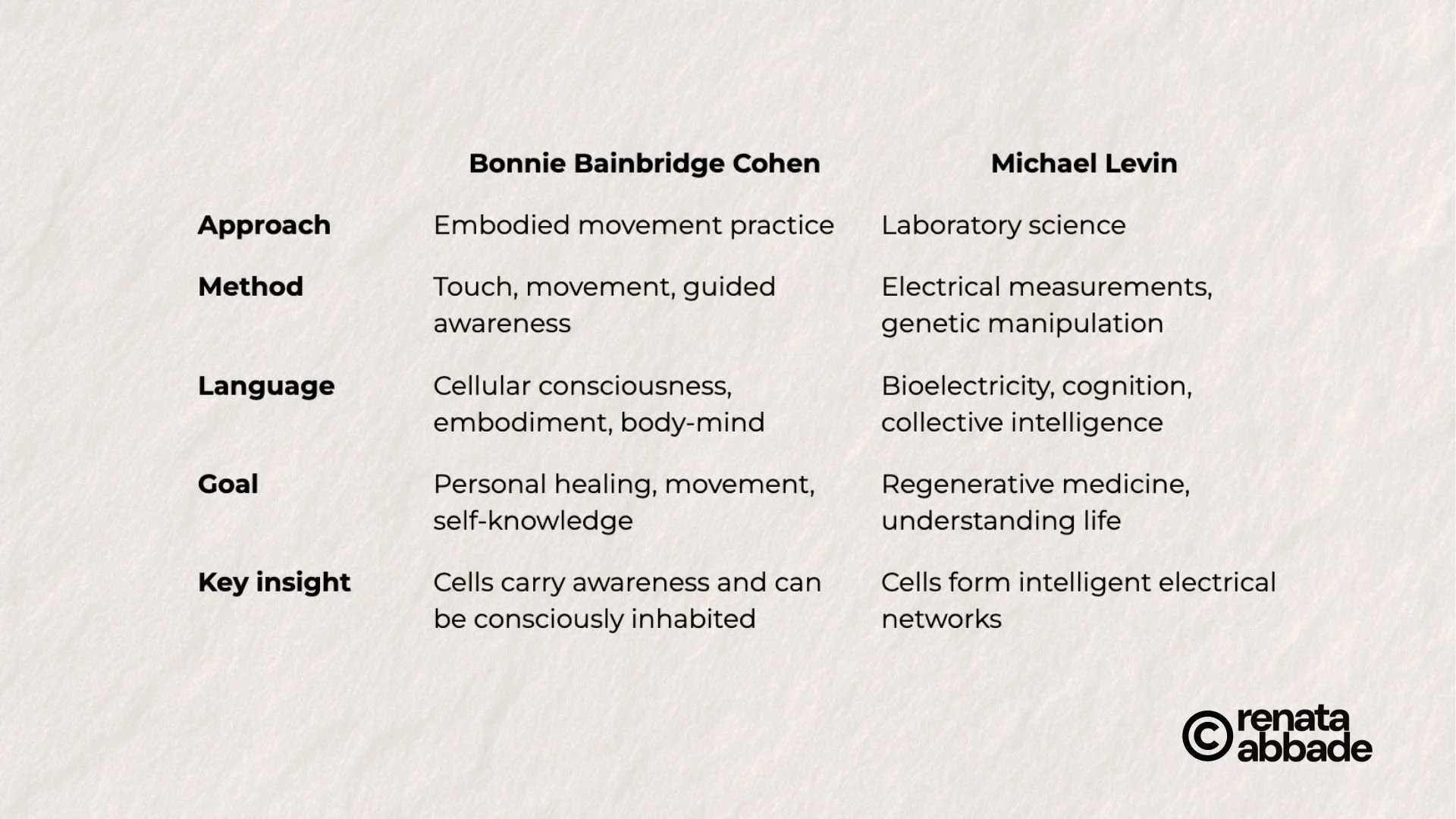
Comparison chart between Bonnie Bainbridge Cohen and Michael Levin
You're Not a Mind. You're Millions.
Why This Matters?
Both Levin and Bainbridge Cohen are pointing at the same elephant from different sides of the room.
Bainbridge Cohen shows experientially that you can consciously exercise this knowledge. By bringing your awareness deeper into your cells, and body systems, instead of just thinking about your body and it’s mechanisms, you become more whole, more coordinated, and more “alive”.
Levin proves scientifically that your body is not a machine run by your brain, rather a community of intelligent agents that have been solving complex problems for billions of years. They talk to each other in electrical language, remember goals, and know how to build and rebuild.
Together, they suggest something profound that challenges the current dominant “neurocentric” approach: Your brain is just one department on your body’s governance structure.
It is one “voice in a chorus”. And learning to listen to the rest of that chorus, whether through science, through movement, or any manner, might be one of the most important things a human being can do.