
truth seekers
The Planning Process We Love To Avoid
Organizations tend to reward action over reflection, execution over examination, but what does that cost us?
Watch what happens when board members or executives are asked to engage in strategic planning. I’m not talking about the performative kind, with the gorgeous decks, and breakout sessions where everyone already knows what we’re going to say. I mean the “real kind”, that starts with an honest look at where we are, how we got here, and where we want to go. This means we don’t know yet how we are going to move forward.
There’s a subtle recoil that precedes a not-so-subtle negotiation: “So, how long will this take?” “Can we skip to the action items?” The affirmative: “We already know what we need to do!” And the finite: “We don’t have time for this” “We are way over capacity!”
If you look a little deeper into it, you can see the undertone: “I don’t want to step into the gap between where we said we would be and where we actually are”. “I don’t want to sit with the discomfort of not knowing”. “I don’t want to face what we’ve been avoiding.”
So, we do what we always do, and skip the reflection part for the sake of “time”. We minimize the data that doesn’t match our story, and we brainstorm solutions to problems we haven’t fully examined. We create plans that are more like wish lists, and we attach timelines to it. Done! It looks and sounds like a plan! Put it on a deck, and it will look pro.
And then we wonder why nothing changes.
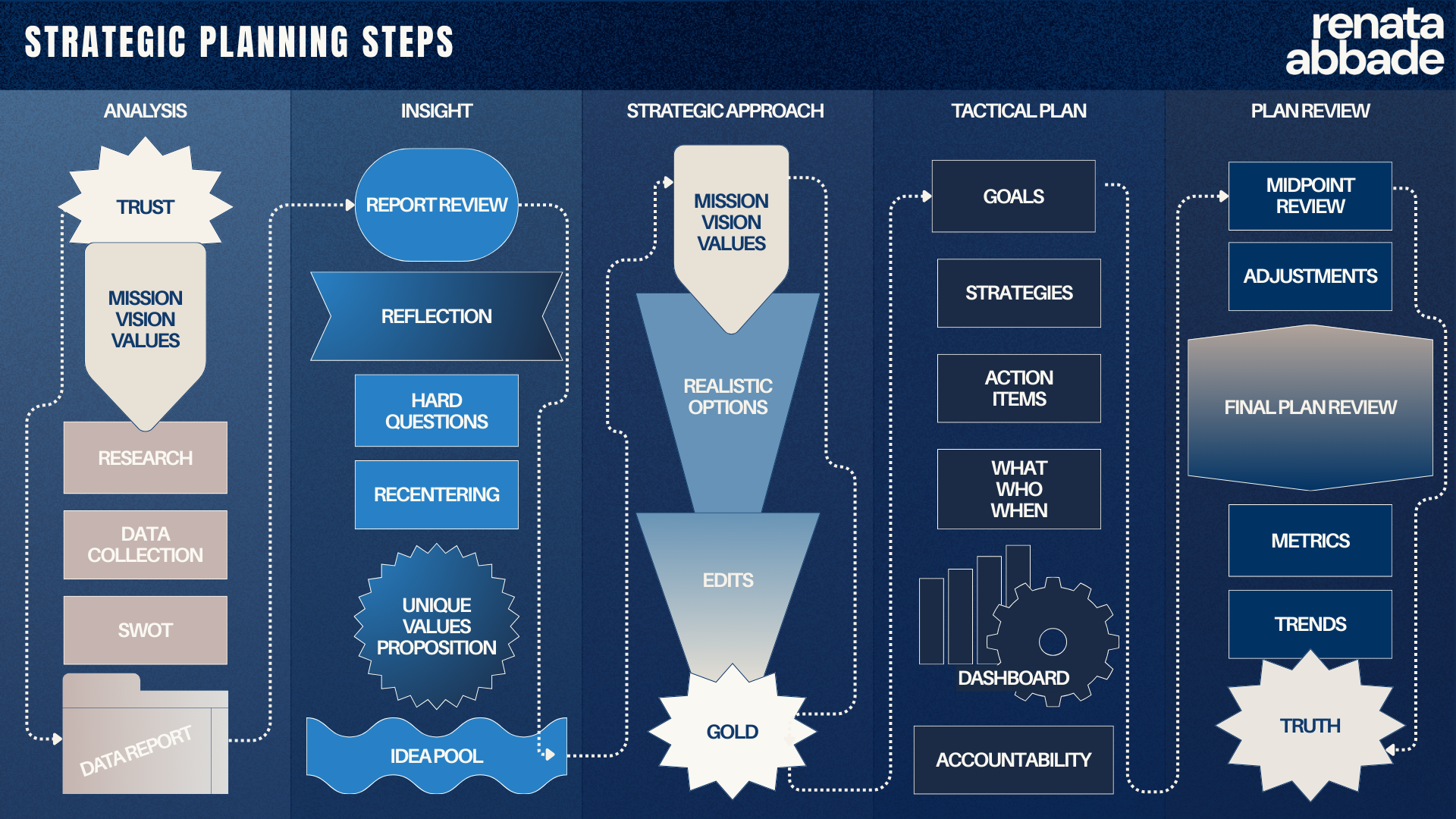
Strategic Planning Methodology by Renata Abbade
“Proper planning prevents poor performance”
The planning process I use isn’t complicated, but it is kind of uncomfortable, if I may call it so, because it asks us to do one thing most institutions have not allowed us to do, which is to tell the truth.
It starts with making sure there is trust, not just in the process, but in each person in the room. Do we trust that we have been living according to our values? Do we all trust the vision? We deliberately and consciously take the time to speak of what we believe, so that we have something to organize around.
Then I run a “background check”, a thorough, both external and internal research. It must include context, previous plans, and diverse set of viewpoints. Culture data is crucial at this step. You have to get to deep listening, translating and decoding, and seek the voices that may not be in the strategic planning room, the people on the ground, doing the work.
The SWOT analysis too, must be brutally honest if it’s going to fulfill its purpose. This is where we look at data, spot the patterns, and force ourselves to report on what’s actually happening, not what we hoped would happen. This is still a diagnosis stage, and we need to run all the tests, and look at all the results, without cherry-picking, and (hopefully) without beating around the bush.
Then comes the part everyone wants to skip: the report review. Which past mistakes we made, were they avoidable, and how much did it cost us? What are our competitors doing that we cannot manage to get to? How do we fail to fulfill our mission?
This is where the lists get long and the room gets quiet. Leaders start confessing the ways they’ve been managing around the truth rather than with it. “We lowered our ambition”. “We stayed in the shallow end”. “We spent more time defending the plan than examining whether it was working”. “We kept ourselves so busy that we didn’t have to face the fact that we weren’t making progress.” “We kept putting out fires” “We forgot what it was we were hoping to solve…”
Clarity gets lost, and the costs show up everywhere. We chase actions instead of impact. We’re no longer the so-called strategic leaders we want to be. We are performing competence rather than embodying it.
Reflection Changes Everything
After we gather and review the data, we reflect. Not in a “Lessons Learned” slide, but in a way that actually touches the pain points. What does it all mean? Why are doing things this way? Where is our true north? And let’s hope nobody brings out a rack card with our set of principles printed with a font size that is too big so “anyone can read it”.
This is where vision and values re-emerge as the actual operating system for decisions. The corporate values wall art becomes completely unnecessary at this stage. From here, we can finally talk about strategic options. Notice: options, plural. We brainstorm to get all ideas out in the open. We hold space for the wild ones, and the practical ones, and even the ones that make us go “oooh”. We don't dive into the first idea, and we don’t keep them stacked in some sort of hierarchy either.
Then comes the sifting. We edit. Edit, edit, edit. Fashion shows were a great learning ground for me to get skilled at this. Which look makes it to the runway and why? What comes before this one, after that one? It needs to be worn by so-and-so. It needs to fit the rotation, and the soundtrack, and we must have the right size of shoes to go with it.
This is the decision sifter. How do we choose the ideas we will, and will not, execute? This is where strategic planning becomes methodology. We're finally being honest about tradeoffs, and we can be fast discermers too.
From Intention to Action (And Back Again)
Only after we’ve done this work do we talk about goals and strategies. What paths do our work travel on? How will we address this? How is this done? What approaches mean we are on the shortest path? How will we measure progress and outcomes? Will we be looking out for roundabouts (those situations that get us running in circles)?
And then (and this is the part that separates real planning from performance planning) we look at red flags, again with honesty. Can we spot warning signs? How can we see if we go off track? What will we do when (not just if) things don’t go as planned? Do we have room to pivot?
The plan itself becomes a living map. We create planning retreats and activities that build connection and shared understanding. We identify the players, who does what and when, and who keeps accountability for actions and progress reporting. We establish action planning to up-skill and manage people and activities. We build dashboard reports that show point-in-time data on a regular schedule, so we can’t hide from the truth.
Then there’s the crucial rewind, the corporate circle-back, and mid-point review. This is not a milestone ceremony, but a real look at where are we now. Can we look back and see if we missed anything? Is there measurable progress? How do we adapt unforeseen conditions? How do we adjust to incorporate new information?
We keep moving forward as planned, trusting that we made the right decisions, cleared up any hiccups, adjusted as needed. We stand on a foundational inner knowing that we have been truthful all along, maybe as we have never been before.
At this point we get back to a place where people want to shrink and hide again: the review of the plan. Now, what progress has actually been made? What goals are actually realistic, and what happened that we didn’t meet them? Nobody wants to admit that their idea didn’t quite work, of course! But our operating system is strong, and we continue to be shamelessly honest, because we chose to do it that way.
What Becomes Possible
When leaders actually commit to this process, stop performing strategy and start practicing it, there’s regeneration. They stop chasing every new idea, and start making choices based on values. They stop defending outdated plans and start adapting to what’s actually happening. They stop confusing activity with progress and start measuring what matters, so it can be scaled. Vanity has finally vanished!
More than that, they start feeling something they haven’t felt in a long time: vitality & creativity. A sense that their work is connected to something valuable. They become the leaders they always wanted to be because they’re present to what’s actually true, genuine. It doesn’t have anything to do with performance.
You probably don’t need a (new or better) strategic plan. You probably already have three or more of them. The question I am proposing here is whether you’re willing to feel the “ick” you keep avoiding getting you through a proper planning process. The question is whether you’re ready to tell the truth. — Renata Abbade